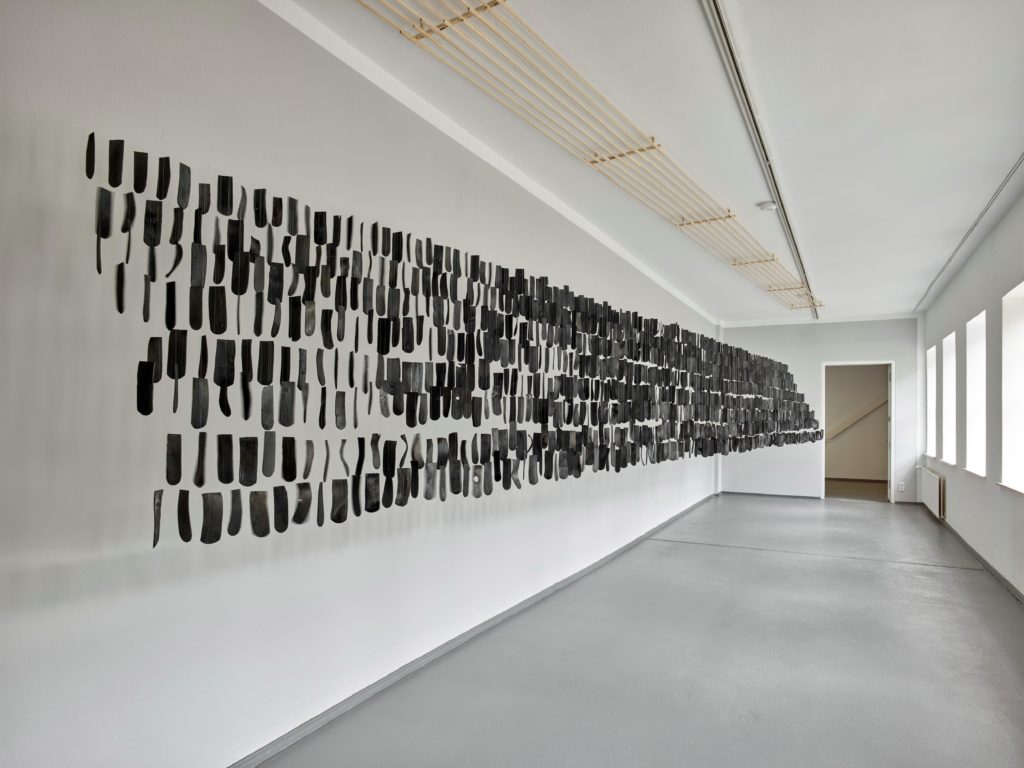
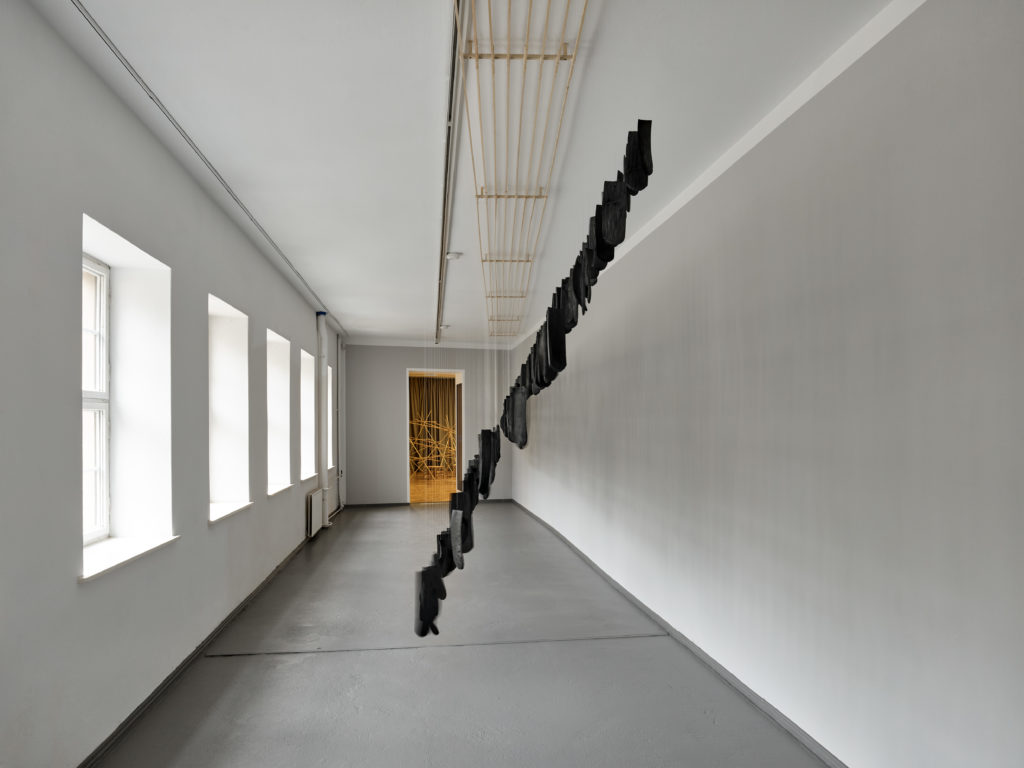
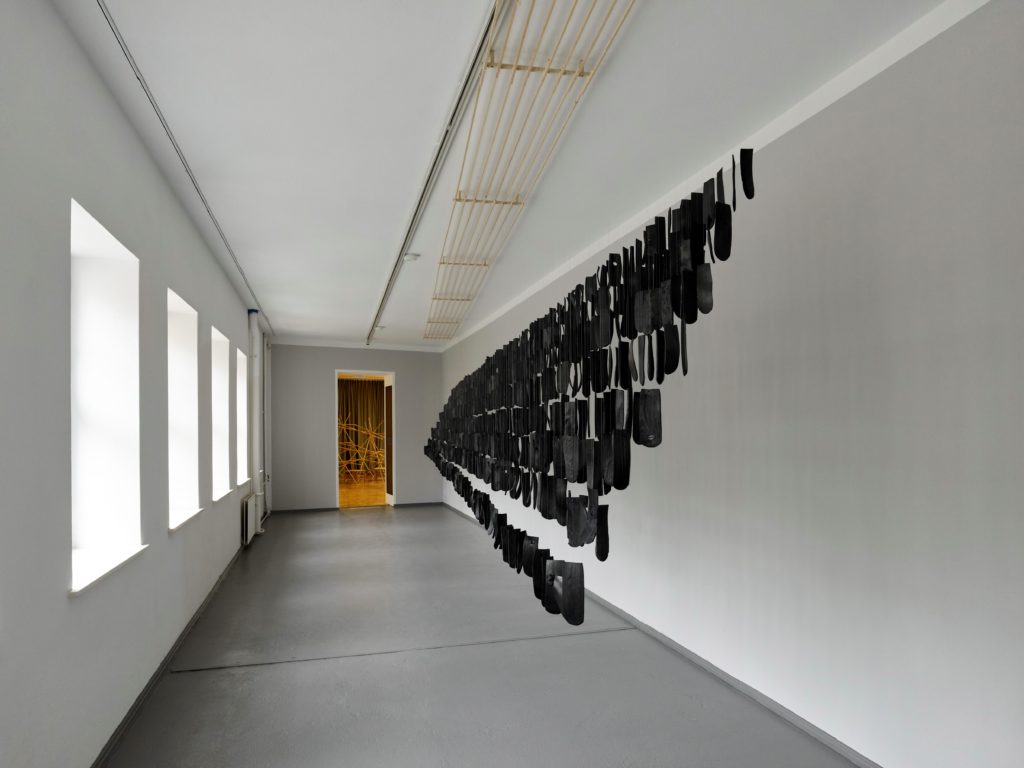
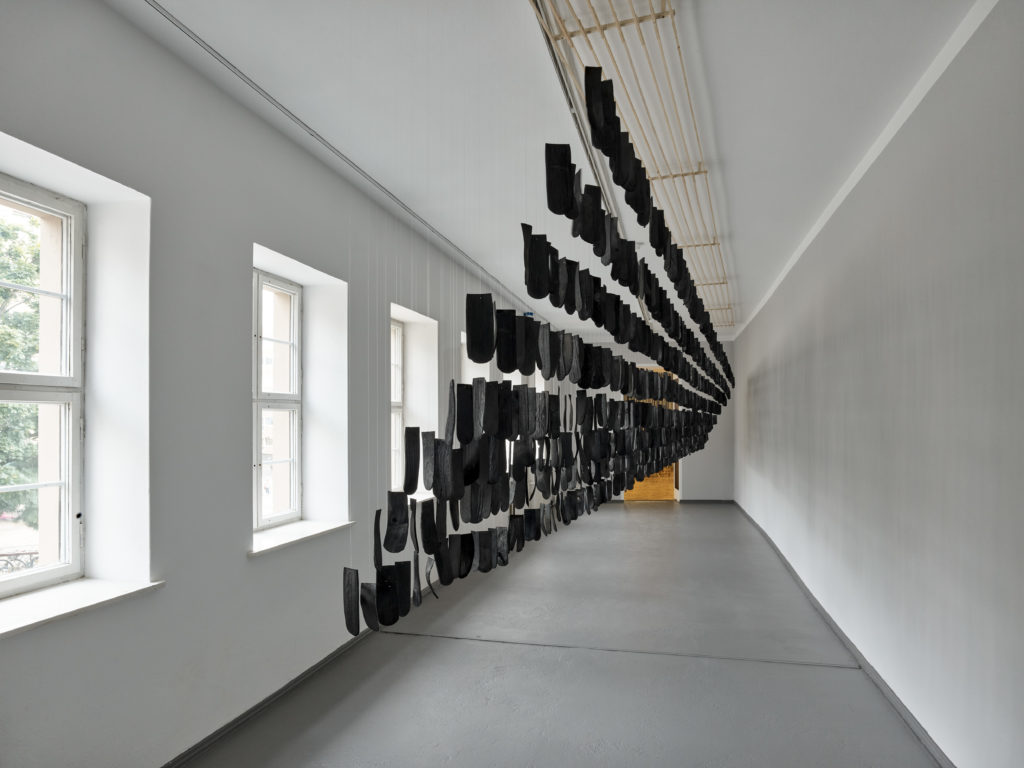
Line of thoughts
Kunsthaus Dresden
June 20 – October 4, 2020
Exhibition “Eine Schwalbe macht noch keinen Sommer”
Spatial drawing with charred shingles, 11 m
AN EXHIBITION OF CONTEMPORARY ART ON CURRENT RELATIONSHIPS BETWEEN CIVILIZATION AND NATURE
Featuring works by Maria Thereza Alves, Melanie Bonajo, Sven Johne, Volker Kreidler, Antje Majewski, Ulrike Mohr, Gabriela Oberkofler, Sonya Schönberger, Iza Tarasewicz, and Lois Weinberger.
Folk wisdom embodies an intuitive, observation-based relationship between humans and nature that has been largely replaced by a technological understanding of nature. “One swallow does not make a summer” is an old and widespread proverb deeply rooted in the experiential knowledge of generations. Today, however, it is unclear whether it still holds true and if we can still grasp its original meaning. Can the migratory patterns of birds still predict the climatic course of summer?
The contemporary artworks in this exhibition, spanning diverse media and research-based practices, trace the shifting relationships between humans and nature and raise critical questions about the future attitudes toward human action.
Humans are part of the natural balance. Our relationships with nature shape not only our languages but also our cultures. While the reciprocal exchanges between humans and their environment—and the lived experiences underlying folk wisdom—are accessible to only a shrinking portion of humanity, profound interventions have altered or even erased and rewritten the laws of nature. The equilibrium of these relationships is severely challenged. Landscapes and ecosystems transformed by civilization can now only be understood as post-natural landscapes.
Alongside the existential threat to the natural balance, awareness is growing for fragile habitats and survival economies, fostering new strategies and connections to ‘ancient’ knowledge. What orientations can be identified in this context?
One Swallow Does Not Make a Summer presents contemporary artworks addressing current relationships between civilization and nature. Through a mix of investigative and intuitive artistic approaches, the exhibition opens up spaces for reflection and encourages shifts in perspective.