On the Consolidation of the Ephemeral: Ulrike Mohr’s Cube contiguous to the Tauber
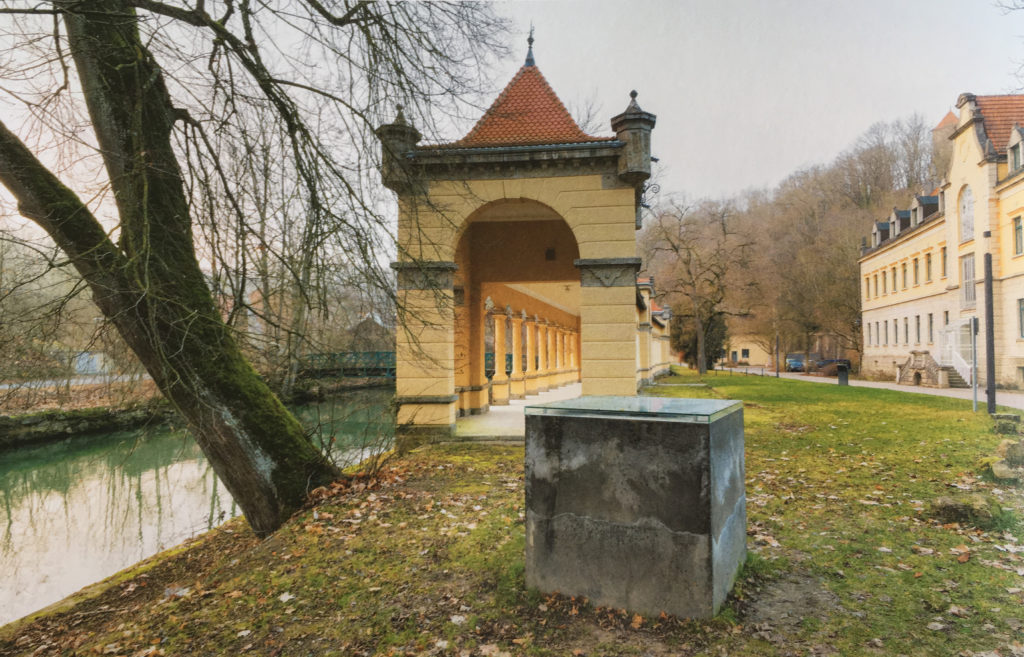
Rothenburg ob der Tauber is one of those descriptive names for a town that directly refers to its surrounding landscape. It literally translates to “Red fortress above the Tauber.” The Tauber is a river traversing through the area of Franconia, in the South of Germany, which has inscribed itself deeply into the landscape over millenniums. The medieval town of Rothenburg was built on a plateau overlooking the river valley, and one has to descend several sets of steep stairs outside the fortification to reach the river bed. These hewn stairs of grey sandstone lead through a hillside park, which belongs to the historic spa hotel Wildbad. The enchanted place has historic roots tracing back to about 1400, when a healing spring was discovered. Today, a historicist building complex from the end of the 19th century stretches along the hillside. It consists of several sections, including a ‘rococo’ hall and a neo-classicist theater, which are again connected via disarrayed sets of staircases. At the bottom, one reaches a free-standing arcade overlooking the river bed. In the fall of 2018, a new element was added to the complex; to the left of the yellow-colored arcade with its repetitive arches, and right next to the Tauber, stands a large concrete cube. When descending the staircase, or upon coming from the hiking path along the river, the solid grey sculpture, measuring 1,20 meters in square, soon appears as a distinctive object to the viewer. Cube contiguous to the Tauber is Ulrike Mohr’s site-specific work, which she created during art residency wildbad.
In its concreteness—both in regard to its materiality and its presence—the cube contrasts with the picturesque landscape and the eclectic building complex. And it, ostensibly, also breaks with Mohr’s main body of work. Her oeuvre is characterized by the use of velvety, deep black pieces of carbonizedobjects. These form the foundation for her fragile and complex installations that oftentimes are evocative of a free-floating swarm—both airborne (Carbon 0112358, 2016) and waterborne (Wasserzeichnung, 2017)— or are developed in relation to the built space of a gallery (Long Walk into another Time, 2015). Known for her practice of applying the historic tradition of carbonization, Mohr has found the carbonization oven to be her artistic medium to transform all kinds of organic matter into enduring objects. Entire trees, cut into slices (Slicing Time, 2016), bushes and shrubs (Anthrakothek, 2013), but also cultural artifacts, such as coat hangers or a bamboo curtain (Pflanze – nicht – Pflanze, 2016) and even a found dead bumblebee are thus turned into shimmering black and condensed versions of their original state. Based on the historical technique of charcoal burning, she (re-)enacts a complex process that unleashes various reactions, such as dehydrogenation. This leads to a transformation in the entire chemical composition of the original material, converting the object into an ever-lasting, yet highly fragile carbonized version of itself.
The first edition of her continuous publication project Anthrakothek (2014) (the term is a compound of ‘anthracite’, hard coal, and the Greek θήκη (thékē) repository) covers the exploration of the magical and chemical process of carbonization, both in her practice and through various contributions in writing. Cube contiguous to the Tauber and Anthrakothek Vol. 2 now mark a new chapter in her practice: Previously, the material for her installations had been the results of what she extracted from the heat; but in the case of her onsite carbonization event in Wildbad, the oven itself has manifested. What usually remains invisible to the viewer, that is the transformation process, has inscribed itself into the landscape—materialized in the sculpture. Mohr has developed a method to transform the oven itself into a sculpture. Yet, when approaching this cube from a distance, that is either via the stairs or the path along the shore of the river, this inherent idiosyncrasy at first remains hidden.
Phenomenologically, the cube is one of those geometric objects that we recognize easily, without having to question whether each side indeed is equal. In his theory and methodology of a Phenomenology of Perception (originally published in 1945), it thus serves French philosopher Maurice Merleau-Ponty as a crucial example for his exploration of how we make meaning of the world through our bodily experience of an object. He argues that it is not primarily our vision, but our relation of our body to an object in a ‘lived-through movement’ that determines how we perceive it. (HIER FUßNOTE 1)
Mohr however, suspends this process of perception by thwarting ones’ (although unconscious) expectation: For the cube in fact does not consist of six equal sides. Upon closer inspection, it reveals its interiority, whereas the top solely is covered with a glass plate. (During the carbonization process, a big metal plate kept the heat inside.) The cube is hollow and bears in its interior the pitch-black traces of its making: Along the thick, grey, concrete shell, the carbonized pieces of an entire tree line the inner surface. Right here, contiguous to the Tauber, Mohr built the cube as an oven to carbonize one of the trees from the landscape park. Similar to the site-specific naming of the town, Mohr’s practice is based on a site-specific relation to the immediate environment. The structure of the bark, along with an entangled ivy twine, molded the inside of the cube. In contrast to the even plane of the exterior, the natural growth of the tree has inscribed itself into the materiality.
Although one perceives of it as a contrast, this inextricable relation between the cube and the tree has a very long tradition. As a geometric object, the cube belongs to the five Platonic solids, meaning it is a polyhedron that is defined by the feature of bearing the greatest possible symmetry—which also intrigued Merleau-Ponty. Within his philosophy, Greek philosopher Plato associates each of the four classic elements (earth, air, water and fire) with a regular solid, assigning earth to the cube. German astronomer, mathematician, astrologer and philosopher Johannes Kepler illustrates this relation in a series of graphics in his Mysterium Cosmographicum (Tübingen, 1596), with the cube depicting a tree on its front face. (Fig. 1) The cube thus marks the specific landscape of Wildbad, and at the same time is a symbol for all landscapes on the surface of the earth.
Formalistically, as well as by the choice of its title, Cube contiguous to the Tauber is ostensibly akin to minimal sculpture. But upon moving closer—similar to the complex process of phenomenological perception—Mohr’s multifaceted field of references gradually unfolds to the viewer: That is, one needs to move and relate oneself to the cube in order to explore its multi-layered state of being. Thus, the cube is rather a reference to process-oriented works, similar to the series of cubes by Eva Hesse, such as Accession II (1968/1969), where the artist constructed a cube based on a grid of galvanized steel plates, in which she inserted flexible material, such as vinyl tubes, to create a soft—and somewhat uncanny—interior (Fig. 2). Another such reference is Robert Morris’ Box with the Sound of Its Own Making (1961) which literally contains the recording of when it was built (Fig. 3).
As a solid object placed in the landscape park along the natural river course, Cube contiguous to the Tauber further relates to the early history of Land art with its simple, monumental geometric forms. The genre of landscape in art has manifested in the work through yet another phenomenon; upon close inspection, the planes of the cube become landscape paintings. Through the production process, that is the horizontal distribution of the liquid concrete into the encasing, different-colored layers have been created, which have formed an abstract landscape: A horizontal line, running around the entire cube, divides the surface into an upper and a lower half. For the viewer, only a narrow trace is visible, which emerges as a line on the outer surface and becomes readable as a flat image. (See p. 6-7, 12-15) It can be both seen as a horizon line and as the abstract image of a topographic map, that is, as the landscape of the earth as seen from above—with the white-blue shimmering line reminiscent of the course of the adjacent Tauber. In contrast to the surface impression of Cube contiguous to the Tauber as a solid form that simply marks a spot on the earth’s surface, from this perspective, it contains a landscape, rendering earth as a place in constant flux.
The effort to manifest the supposed contrast between permanence and transience in a work, runs through Mohr’s artistic practice. This relationship has its dialectical suspension in the form of charcoal: An object is removed from its inherent, continuous temporality, and instead is placed in a permanent state—for the charcoal is enduring, but at the same time fragile. In the project series WECHSELRAUM (since 2015), this seems to be the other way around, as the performative project entails a radical turning away from stability and turning to the ephemeral: Mohr has conceived a collaborative exhibition as a performative format, which, in the double sense of the word, offers space for performances and artistic interventions of very different kinds. For the transdisciplinary project, Mohr invites several collaborators, primarily artists, but also dancers, scientists and authors, each of whom she assigns a period of time within which they work in and with the changing space. Everything that has happened in and during the WECHSELRAUM so far, becomes the material for the next partaker. The space is therefore in a process of constant change. The point of departure always is one of Mohr’s fragile, charcoal installations, which again and again becomes the material for other works.
Within her long-term art residency, Mohr realized one edition of WECHSELRAUM in Rothenburg in the fall of 2018 (23. – 24. November). The 24-hour-long exhibition project began with the partial ‚destruction‘ of one of Mohr’s fragile carbonized installations, which she constructed from the ivy twines of the carbonized tree inside Cube contiguous to the Tauber. As a material and instigator for this continuous one-day transformation process, she had installed the free-floating carbonized ivy twine in the open space of the former swimming pool of Wildbad. (See p. 50) During the first slot of two hours, Florian Dombois asked the participants to grind the wooden charcoal to then turn it into black powder for his work Volcanoes on the Road. Once unlit, the firework marked the beginning of the transformation process of WECHSELRAUM, which was then handed over to the partakers in the following order: Jasmin Schaitl – Max Sudhues – Hannah del Mestre & Lukas Kleinert – Justus Weiß – Katja Pudor & Nicole Wendel – Judith Weber – Ilona Kalnoky – Georg Winter – Matthias Beckmann – (again) Katja Pudor & Nicole Wendel – Alice Goudsmit. At first, the processual project appears to be entirely ephemeral, as it is temporally and spatially limited to one place and a certain number of days, or even simply a few hours. Yet, similar to the one spark that lit-up the firework, WECHSELRAUM is only the starting moment for a larger process that rumbles on within the work of the many artists involved. The ‘destruction,’ therefore, is nothing final, but takes on ever new forms, and within Mohr’s work has to be understood as method for exploring potentialities. It merely is the beginning of an ongoing process of transformation—such as in the case of Cube contiguous to the Tauber, which now belongs to this specific landscape.
(1) Merleau-Ponty, Maurice. Phenomenology of Perception, London/New York: Routledge, 2005, p. 237.
(Fig. 1): Assignment of the cube to the element earth in Johannes Kepler’s Mysterium Cosmographicum Libri V, Tübingen, 1596, p. 53. (Published in: Johannes Kepler, Welt-Harmonik, München & Berlin: Verlag R. Oldenbourg, 1939, p. 74.)
(Fig. 2): Eva Hesse, Accession II, 1967/1969, galvanized steel and plastic tubing, 30 3/4 x 30 3/4 x 30 3/4’’. Detroit Institute of Arts. (Reproduced in: Ursula Panhans-Bühler, LERNE ZAPLN TOD. EVA HESSE, WEIBLICHER TRICKSTER, Parkett 36, 1993, p. 13.)
(Fig. 3): Robert Morris, Box with the Sound of Its Own Making, 1961. Walnut box, speaker, and three-and-a-half-hour recorded tape of the process of building the box, 9 3/4 x 9 3/4 inches (24,8 x 24,8 x 24,8 cm). Seattle Art Museum. (Reproduced in Robert Morris The Mind/Body Problem, ex. cat., New York: The Solomon R. Guggenheim Museum, 1994, pp. 104-105.)
Friederike Schäfer, 2019